Baby’s first tooth: Parents can’t wait to see that little white tooth poking through for the first time. It’s an important milestone for your child, but it also means “teething” has begun in earnest. No sooner are the teeth in than they start to fall out.
What’s the timeline for getting and shedding baby teeth? Once that first tooth is in, how long before the second one comes along? When will your baby lose their first tooth? Parents often have questions about their child’s teeth timeline, and the Center for Pediatric Dental Health is here to answer them!
When Will Baby’s First Tooth Come In?
If your child starts getting fussy at about six months of age, you may be seeing that first tooth soon! The central lower incisor (front lower center tooth) usually comes in between 6-10 months.
About two months later, you can expect the first upper tooth to make an appearance. The central upper incisor usually comes in about 8-12 months.
After that, the upper and lower teeth usually alternate on eruption, with the other central incisors coming in, followed by the lateral incisors on either side. Canines soon join those front teeth, then the baby molars.
(Fun fact: Unlike adults, babies don’t have premolars! You won’t see bicuspids until they replace the baby molars, which will fall out just before their teens.)
So what’s the timeline for baby teeth erupting? Here’s a general guideline.
Central incisors: 6-12 months
Lateral incisors: 9-16 months
Canines: 16-22 months
First molars: 13-19 months
Second molars: 23-33 months
There is quite a range in age for each tooth. It’s OK if the first tooth comes in at 9 months instead of 6 months, or if the first molar comes in at 16 months. All of your child’s milk teeth should be in by age 3.
Delays in Baby Tooth Eruption
What if baby teeth are delayed a lot instead of a little? One or two months is one thing, but if your child is delayed by several months, there could be an issue.
What causes delayed tooth eruption in children? There could be several factors involved.
Genetics is one of the most common causes. If you were late in getting your first tooth, there is a chance your child will have late tooth eruptions, too. Certain genetic conditions can also cause delayed tooth eruption, including Down Syndrome, amelogenesis imperfecta, and regional odontodysplasia.
Children born premature or with low birth weight may also have developmental delays that can include delayed tooth eruption. Much of that can be simple math — a baby born two months early may be 6 months old, but developmentally is only at 4 months.
Children with vitamin or nutritional deficiencies can have delayed tooth eruption, including children with vitamin D-resistant rickets. Other developmental disorders can delay tooth eruption, including hypopituitarism, a pituitary gland disorder.
If your child’s tooth eruption is delayed by up to 18 months or if your child’s gums are abnormally discolored or swollen, schedule an appointment with the Center for Pediatric Dental Health. We can examine your child to determine possible reasons for the delay and to assess whether their teeth are still developing normally.
The American Dental Association recommends that your child have their first dental visit by the eruption of the first tooth or by age 1, whichever comes first. Rest assured, we can examine your child during that visit to make sure their teeth are developing normally.
Losing Baby Teeth
It isn’t long after the primary teeth come in that they start falling out again. Why do deciduous teeth fall out so soon? Your child’s first teeth are there so they can learn how to move from mother’s milk to solid foods. Still, they start small with softer foods.
By age 6, when the first tooth starts to loosen, your child should be ready to eat just about any kind of food. However, their small milk teeth aren’t made for the long-term biting, grinding, and crushing that adult teeth can handle. So it’s time for out with the old and in with the new!
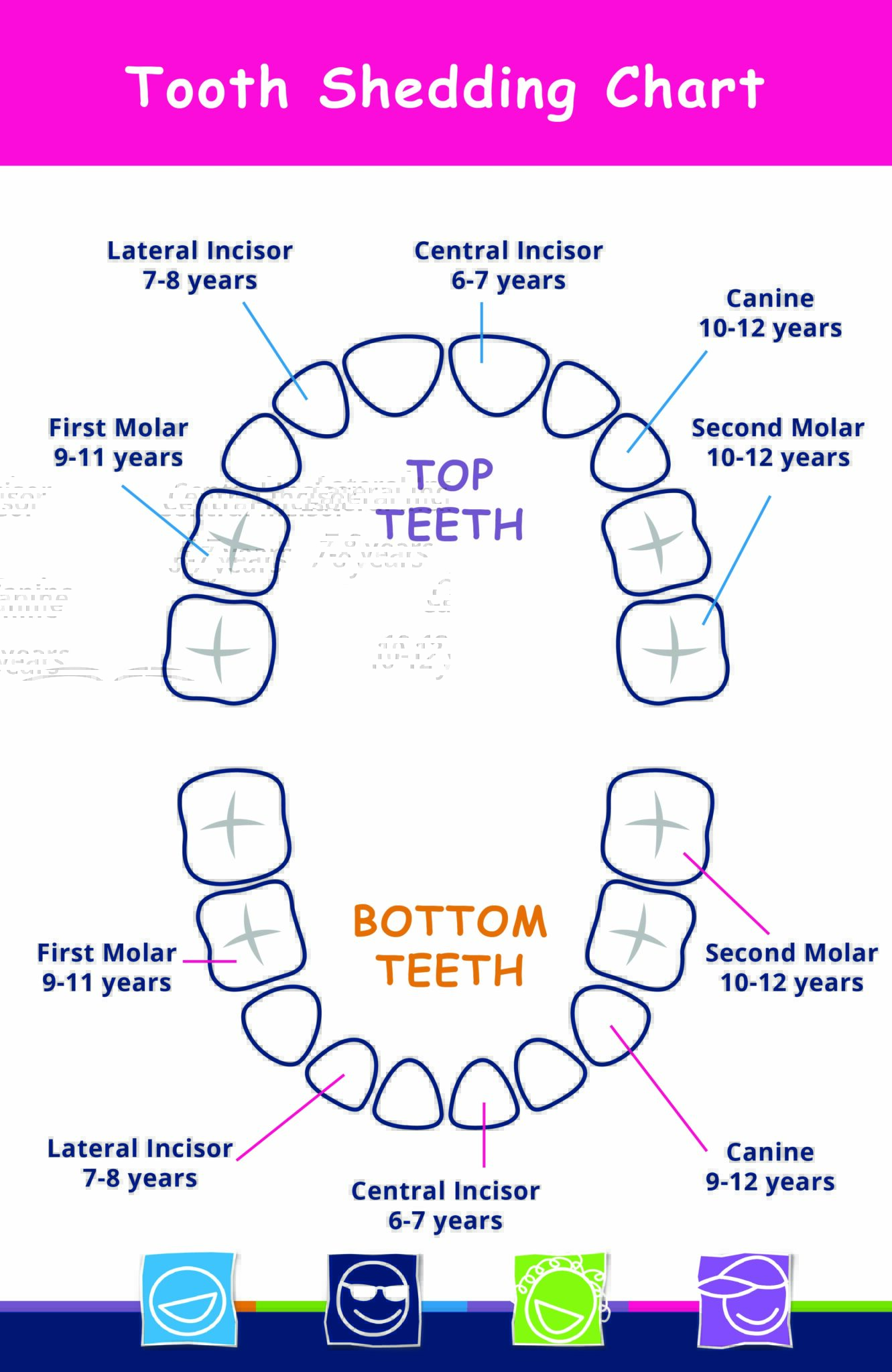
Baby teeth start falling out about 3 years after the last tooth erupts, around age 6. They usually fall out in the order in which they erupted, so expect that lower central incisor to be the first to go!
From there, the upper central incisor is likely the next to fall out. Then, as with baby tooth eruption, the baby teeth will shed alternately between the top and bottom teeth and move from front to back.
The last teeth to come in — the second molars — will be the last to come out, usually around age 12. They’ll be replaced by premolars, which tend to come in after the first molars, which erupt first behind the baby molars/permanent premolars.
By the time your child is a teenager, they will have most of their permanent teeth in. The last to come in are the wisdom teeth, between the ages of 17 and 21. Once they’re in, your child has their complete set of permanent teeth.
(Fun fact: Not everyone will have a complete set of wisdom teeth. In fact, nearly one-third of Americans will have less than four wisdom teeth, and a quarter of those will have none at all.)
Here’s a general timeline of when your child will get their permanent teeth:
Central incisors: 6-8 years
Lateral incisors: 7-9 years
Canines: 9-12 years
First premolars: 10-12 years
Second premolars: 10-12 years
First molars: 6-8 years
Second molars: 11-13 years
Third molars (wisdom teeth): 17-21 years
FAQs About Teeth Eruption and Shedding
Do you have more questions about losing and getting teeth? Here are a few we’ve heard and can answer for you.
Check with us. If a tooth falls out or is knocked out early, we may need to place a spacer there until the permanent tooth is ready to come in. Otherwise, the surrounding teeth may move into the space, crowding out the erupting permanent tooth later.
It’s not that unusual. If one tooth is delayed, it may come in at the same time as another. It’s usually not a problem, except your baby may be even more uncomfortable with teething.
The permanent tooth may break up the baby tooth or may push it out of the way. The baby tooth should eventually come out. If not, give us a call, and we can pull it before it crowds out the permanent tooth.
All those old tricks you heard in your youth may actually cause damage to your child’s jaws or gums. The tooth should come out naturally. Encourage your child to eat soft foods and to brush gently to avoid further gum irritation. No tying strings to doorknobs.
Caring for New Teeth in Sicklerville, NJ
Whether your child has their first tooth or last coming in, the Center for Pediatric Dental Health is here to ensure your child’s good oral health. Your child needs to see a dentist as soon as that first tooth peeks out.
Whether you’re worried about the first tooth or the last, the Center for Pediatric Dentistry is here for you and your child. Schedule an appointment today for pediatric dentistry in Sicklerville, NJ, Woolwich Township, NJ, or Mount Laurel, NJ, and we will help your child keep those new teeth healthy and strong!